10-month residential Diploma Course in Kattaikkuttu (Oct-2026-July 2027) Fee ₹ 80,000; this includes tuition, dormitory accommodation and food3½-month residential Certificate Course: Oct 2026 to mid-Jan, 2027: Fee ₹ 35,000
*
10-month residential Diploma Course in Kattaikkuttu (Oct-2026-July 2027) Fee ₹ 80,000; this includes tuition, dormitory accommodation and food3½-month residential Certificate Course: Oct 2026 to mid-Jan, 2027: Fee ₹ 35,000 *
Who is this course for?
Artists, lovers of Tamil, and performers seeking serious artistic growth and cultural immersion in a multi-facetted, grounded Tamil theatre. Are you ready to challenge yourself and your perspective on what is acting?
Kattaikkuttu isn't just a performance. It is a sensorial philosophy that thrives where the rural landscape meets the modern world. This diploma course offers a sustained, rigorous training that redefines your relationship with your voice and bodymind, while opening up a "bottom-up" inquiry into society and into who we are and why we continue to make this theatre.
What will you learn?
Join Master Teacher Perungattur P. Rajagopal and his team of expert teachers and musicians for a transformative journey where you will:
Familiarize yourself with the framework that underlies every Kattaikkuttu performance
Familiarize yourself with the playscript through ensemble singing while finding out different interpretations of the Mahabharata
Learn a number of basic elements that structure the performance, e.g., musical introduction and opening songs (melakkattu), division between on stage lead singer(s) (munnani) and backstage chorus (pinnani), difference between pattu and viruttam
Learn to perform structured routines, e.g., entry of the Kattiyakkaran, curtain entrances of kattai vesams, entry of female characters
Acquire multiple building blocks prompted by the framework; these building blocks involve different media and include songs, prose passages, comic interludes and musical and choreographed transitions allowing you to literally assemble the performance on stage
Learn a specific role
Perform this role in a production before a live audience at the conclusion of three months of training.
Master the Voice
Voice is the most private and internalized tool a performer has. It supports singing, speaking and movement, creates space, defines identity, and accesses emotions that sometimes cannot be expressed through words. In contrast to other South Indian performance forms, such as Bharata Natyam and Kathakali where the voice has been relinquished to a professional background singer, Kattaikkuttu performers have retained their voices. Their powerful and at times virtuoso singing helps shape Kattaikkuttu’s characteristic sound scape.
Catching the HIGH pitch
Kattaikkuttu performances happen outdoors and remain largely unamplified. Rajagopal teaches his students to sing in a high pitch. Not only is this an aesthetic characteristic of the Perungattur style, high pitched singing carries further and ensures it reaches spectators seated far away. In addition, coming from within and supported by breathing, the voice is pivotal to propel a performer into character. You will learn to:
project your voice without amplification, reaching the high pitch required for outdoor shows
sing in tune as a member of the Kattaikkuttu ensemble and as an individual actor
modulate your voice according to the character and her/his context
follow the flow of the melody to create scope for melodic and octaval variation
regulate your breath to support singing and movement
Master the language
Kattaikkuttu is a Tamil language-based form of ensemble theatre; a dexterous use of Tamil is pivotal to all its performances and to the spectators’ emotional reception thereof. The Tamil language defines itself as words, music and visual imagery(iyal, icai, nāṭakam). This means that Tamil needs to be performed in order to reach its full aesthetic and emotional power. Kattaikkuttu, as an expression of Tamil, uses the full linguistic range of the language—from the most colloquial to the highly literate—as a dramatic tool to bring epic characters to life. You will learn to:
interpret text as a linguistic and a musical medium
split and pronounce the words of a verse so that they seamlessly fit the rhythm
pronounce with precision to bring out diction, rhyme and rhythm
construct your own Tamil prose passages, which are not scripted “givens”, using points of reference from preceding songs or in response to questions of the Kattiyakkaran
Master the movement vocabulary - learn:
the body language of different characters—male, female, comic, royal, servant, sage
spacial awareness: where you are in the performance space in relation to others
different kinds of walks (naṭai)
different kinds of dance steps (aṭavu), jumps (tuḷḷal), spins (kirikki) and dance patterns
move individually and as a group
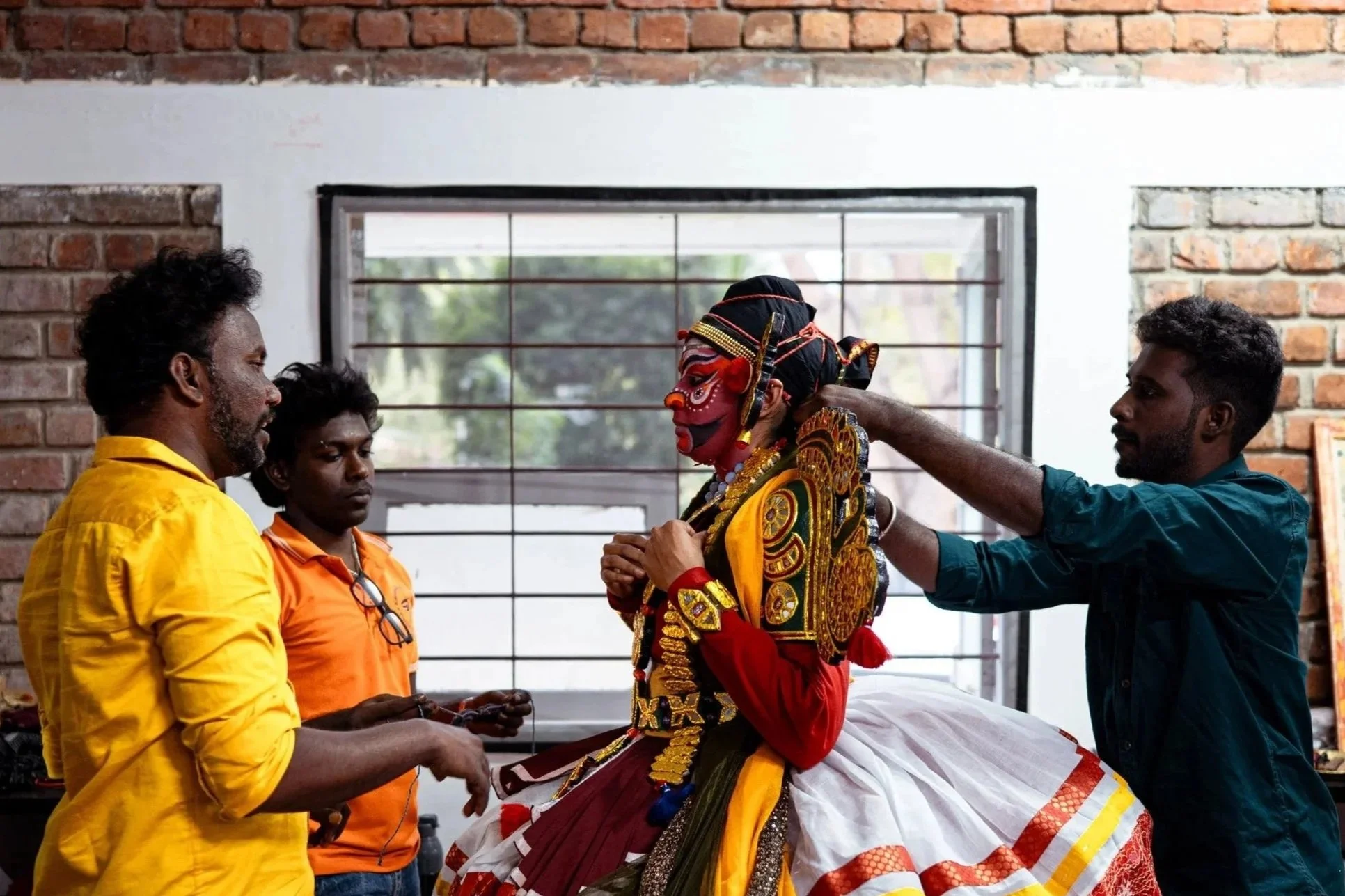
combine movement and expression with singing and acting while wearing Kattaikkuttu’s costumes and heavy ornaments (nadai-udai-pavanai).
Acting: Embody the Vesam
Be the character—Use your growing proficiency in Kattaikkuttu’s multi-media tools to move beyond rote learning to embody and interpret a role. You will learn:
the score of an individual role or vesam
the relationship between self and character
the role of comedy and the labour of the Kattiyakkaran in an all-night performance
make-up specific to your character
to wear Kattaikkuttu’s characteristic ornaments and costumes while performing
Moreover, you will have the opportunity to
learn to play one of Kattaikkuttu’s instruments (harmonium, mridangam and mukavinai)
participate in weekly Karnatic vocal classes
participate in a weekly academic session familiarizing you with Kattaikkuttu, its history and contemporary status