

Latest News
Job opportunities
NEWS
UNESCO NGO ACCREDITATION
We filed the application for UNESCO accreditation as an NGO preserving Intangible Cultural Heritage on 29th March, 2025. We received our NGO accreditation on 12 August 2026 under the 2003 UNESCO convention for the safeguarding of the intangible cultural heritage.
We are happy and honored to now be part of the global ICH NGO forum as one of the few NGOs in India to have received this accreditation..
Links:
2003 Convention’s Website
Accredited NGOs: https://ich.unesco.org/en/accredited-ngos
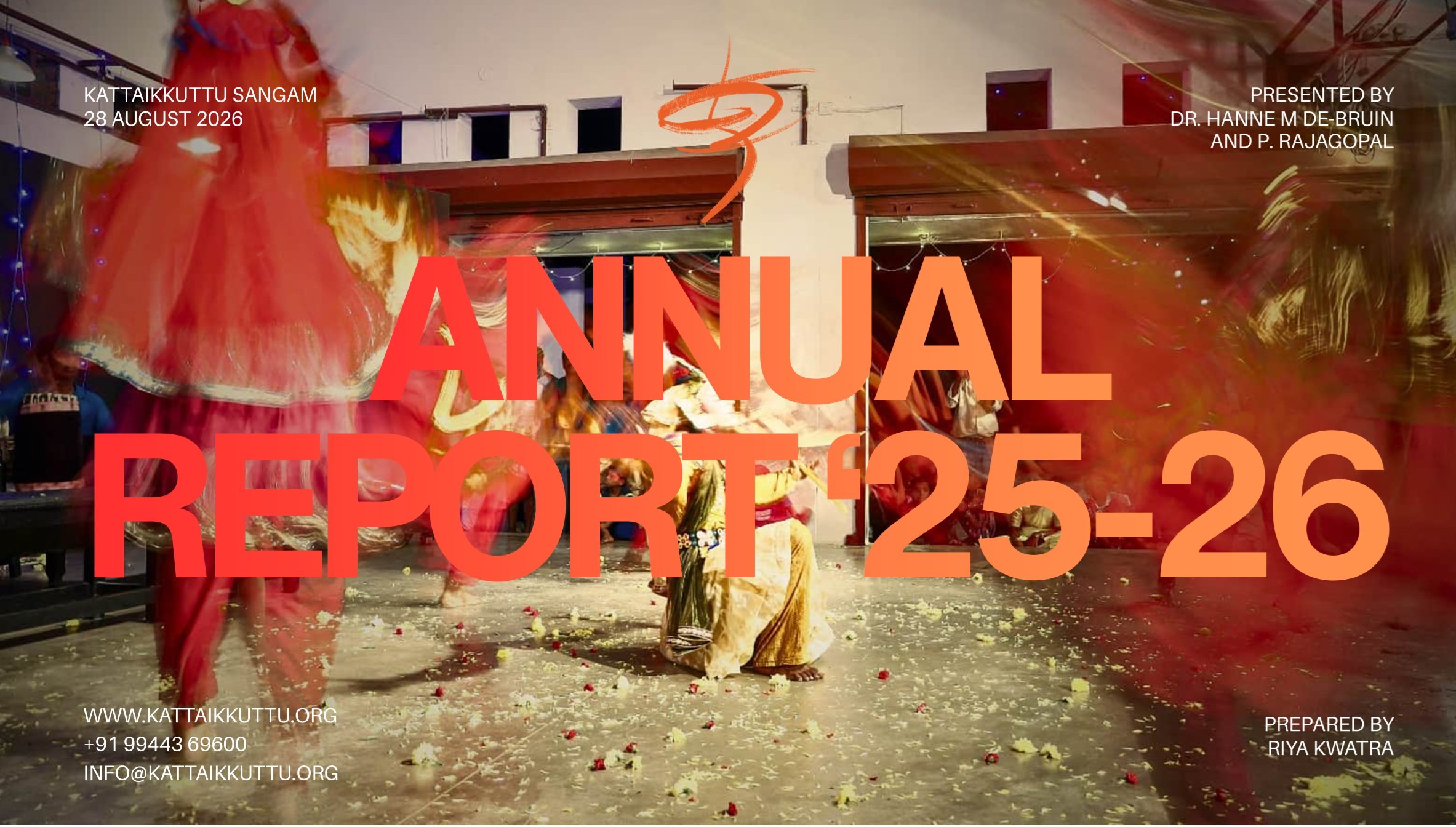
ANNUAL REPORT 2025-2026 is out
The Sangam’s Annual Report and Financial Statements for the year 2025-2026 were approved during the General Body Meeting on 28 August 2026. You can read the Annual Report, including a summary of the finances of the organization, here.
Job opportunities
Kattaikkuttu Sangam Fellowship
(mid-Oct 2026 to mid-Jan 2027)
We invite videographers, photographers, archivists, researchers and designers to apply for a 3-month fellowship at the Kattaikkuttu Sangam in Punjarasantankal Village, Tamil Nadu.
Stipend: ₹30,000 per month, with accommodation and food costs covered by the recipient
Duration: 15 October 2026 to 15 January 2027
Application Deadline: September 15, 2026
Link to Job description in Tamil
About the Program
Kattaikkuttu Sangam is a not-for-profit association dedicated to Kattaikkuttu (or Terukoothu), a traditional Tamil language-based physical and vocal ensemble theater. In October 2025, the Sangam launched a Kattaikkuttu Diploma Course that offers immersive training in acting, singing, movement, makeup, and costuming. Participants will also have the opportunity to learn to play a musical instrument, such as the harmonium, mridangam/dholak, or mukavinai. The Diploma Course is designed to prepare students for roles in Kattaikkuttu theater, contemporary theater, and the film industry.
Alongside the Kattaikkuttu Diploma Course, the Kattaikkuttu Sangam aims to create an online Repository for Kattaikkuttu that captures the multifaceted knowledge system of the theatre, highlights its transmission, and showcases the skills and versatility of its professional practitioners.
Your Contribution
During the fellowship, you will engage in the Sangam's daily activities, using your skills to enhance its mission. Possible contributions include:
Photographing and Cataloguing the extensive costumes, makeup and ornamental traditions used in Kattaikkuttu as an input for the Digital Repository (photography experience is required)
Assisting with subtitling of video footage from Kattaikkuttu performances and classes for the Digital Repository (fluency in Tamil and video editing experience is mandatory for this)
Who Can Apply
Applicants can include, but are not limited to, actors, musicians, researchers, dancers, curators, (video)photographers, archivists, crafts persons and writers—there's no age limit. Proficiency in English is required; knowledge of Tamil is a great plus.
Non-Indian citizens can apply but will not receive a stipend; instead, we will provide accommodation and assist with visa arrangements.
Duos may apply, but the stipend will remain the same.
The Sangam believes that all art forms count equally and should be inclusive and accessible to all.
How to Apply
Email us with your CV, 2 recommendation letters and a motivation letter at info@kattaikkuttu.org
Please mention which of the two roles you are applying for!
Interviews
Online interviews will take place by the third week of September, with results announced immediately thereafter. If you are selected, we will request a professional background check or a signed and dated declaration confirming that you have no criminal history.
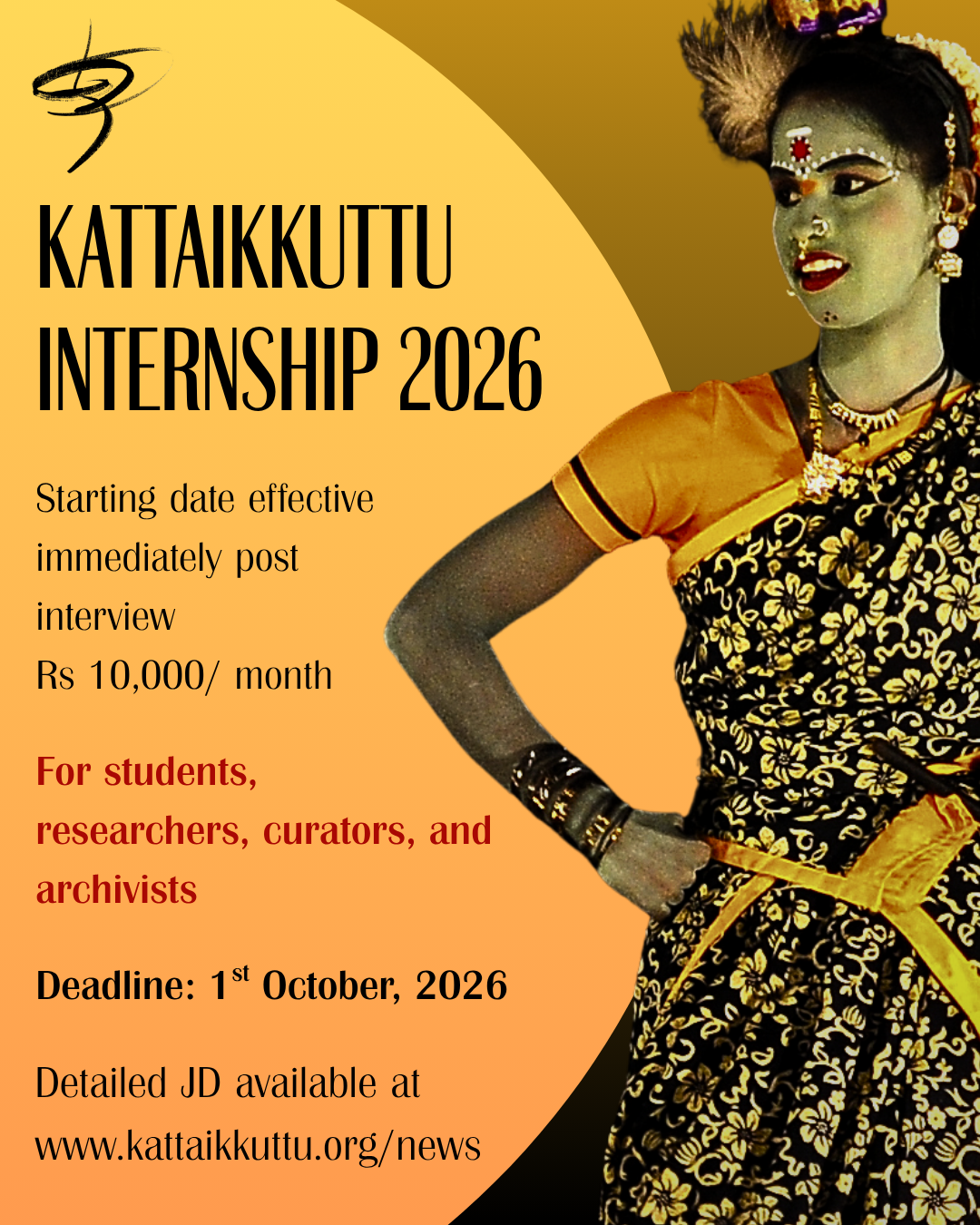
Kattaikkuttu Internship
(3 months; per immediate)
We are seeking two dedicated interns to assist us with our ongoing archival and library initiatives. This is a unique chance to work directly with a significant collection related to performances traditions, in particular Kattaikkuttu (Terukoothu).
Stipend: ₹ 10,000 per month with onsite accommodation
Duration: 3 months; per immediate.
Application Deadline: 30 September 2026
Link to Job description
Your primary mission will be to build a structured and accessible archive and reorganize the library of the Kattaikkuttu Gurukulam, which has been dormant since 2020 when the school had to close because of the pandemic. The collection included Tamil language handwritten and printed materials, photos, audio-cassettes, videos and paraphernalia. You will play a vital role in digitizing and making accessible this rich cultural heritage.
Who can apply
You have a degree, read and write Tamil. are super well organized and punctual and can handle basic computer and digitization tasks (Excel, Word). Video editing skills are welcome.
How to apply
Email us with your CV, motivation and skills at info@kattaikkuttu.org.
This is a junior position and you can start immediately.
INTERN FACILITIES MANAGEMENT
Additionally, we have an opening for someone who’d love to help out with facilities management. You love taking care of people, making students comfortable and helping out with the cooking and the cleaning; you love dogs (there are 3 of them on site). Perhaps you are a good cook and would like to try your hand at cooking sometimes for a group of 50…
The same conditions apply as for the Archive and Library Interns (see above).
We are hiring! (closed)
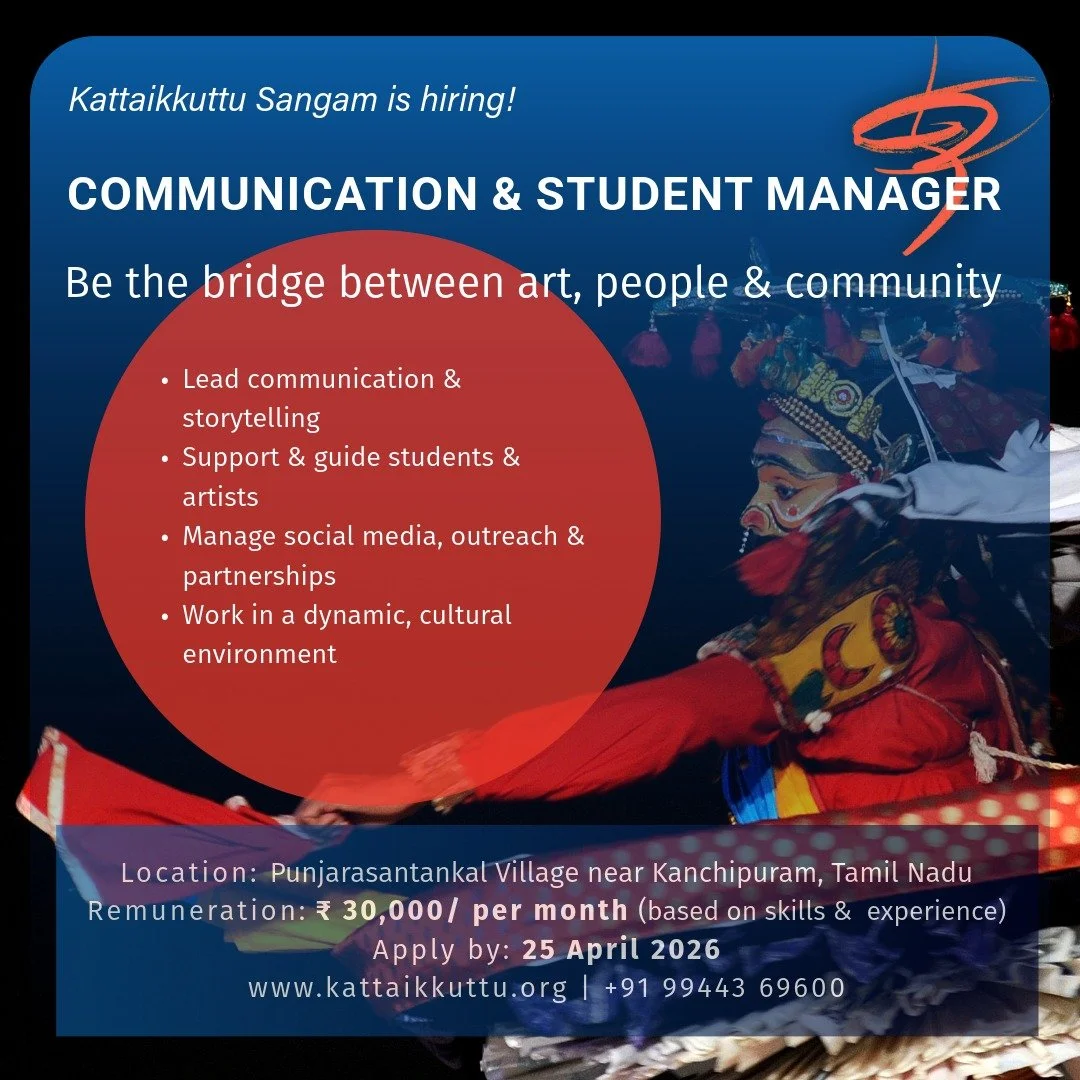
“Are you someone who loves working in the performing arts with people from diverse backgrounds and convince people that Kattaikkuttu is a powerful theatre that deserves wider recognition in the arts world?”
Kattaikkuttu Sangam seeks a
Communication- and Student Manager
Punjarasantankal, March 21, 2026
Reimagining La Bayadère
Hanne M. de Bruin
On March 26, the Dutch National Ballet (DNB) will present a new production of the famous 19th-century ballet La Bayadère, featuring a substantially revised storyline. The creative team—Rachel Beaujean, Kalpana Raghuraman, Dr. Priya Srinivasan, and Ted Brandsen—has deliberately distanced their libretto from the orientalist perspective of the original version of the ballet that premiered in St. Petersburg in Russia in 1877. This original version featured elements that are deeply problematic by contemporary standards. It presented a fantasy India bearing no resemblance to historical reality, populated by stereotypical fakirs, exotic temple dancers in diaphanous harem pants, a lascivious Brahmin, and a confused jumble of religious symbols—including a dancing Shiva in gold lamé and a Buddha statue. Most notoriously, it featured young dancers performing in blackface to emphasize their racial otherness, reminiscent of the Dutch Zwarte Piet tradition.
The ballet's titular character, the bayadère—from the Portuguese balhadeira (dancer)—is often conflated with a devadasi, a female temple dancer who was ritually married to a Hindu deity. The devadasis or “servants of God” occupied a complex social position: neither courtesans nor nuns, they were accomplished artists whose dance combined spiritual devotion with sensual expression. They often were supported by wealthy patrons.
A Parallel Production: Paarvai or The Gaze
While DNB developed their revision, a smaller-scale musical theater production was taking shape in a South Indian village. Paarvai or The Gaze, created by Indian theater actor-singer P. Rajagopal and myself—a Dutch Indologist and dramaturg—emerged from our shared frustration with the stereotypical representation of the bayadère. In the original ballet, she exists primarily as a sensual spectacle for the elite European (male) gaze, with little agency beyond her self-chosen death when her beloved marries her rival.
As part of my research for Paarvai, I initiated a correspondence with DNB in late 2022 that led to a brief, yet intensive online exchange with assistant artistic director and former DNB dancer Rachel Beaujean. I was curious: how is the “Indianness" of the bayadère expressed through movement? How much interpretive freedom do dancers have in this technically demanding role? Rachel arranged interviews with two principal ballerinas, Anna Tsygankova and Anna Ol, who both danced the role of the bayadère. Anna Ol described it as "a dramatic role in which you can truly act, not just execute classical steps." She also noted that while "the legs perform classical movements, the upper body is remarkably free" in the first act. Watching the earlier 2016 DNB production, Rajagopal and I were captivated by the bayadère's movements in this section: hands intertwined overhead suggesting a serpent, the torso at times arching far backward while maintaining precarious balance on pointe. Yet these ethereal, skyward-reaching movements seemed fundamentally at odds with South Indian classical dance, which emphasizes groundedness and connection to the earth.
At the time of our exchange, funding uncertainties threatened the DNB’s proposed production of La Bayadère in 2026. Rachel and I parted ways, each pursuing our separate projects.
Reclaiming Agency for the bayadère
Paarvai is our artistic response to La Bayadère—a ballet that, as Palestinian-American scholar Edward Said might argue, reflects and legitimizes Western cultural superiority and colonial power through its orientalist lens. In our production we shift the colonial European gaze to 19th-century South India, zooming in on the lives of ordinary people—those "exotic blackfaces" whose stories unfold beyond the sight lines of colonial and indigenous elites. Our protagonist, Kamaladevi, is a celebrated actress in the Kattaikkuttu theater tradition—a woman with agency, ideas, and determination. We asked ourselves: How did she see the world? What were her thoughts and feelings?
My research revealed a shocking coincidence: the premiere of La Bayadère in 1877 occurred simultaneously with the Great Madras Famine of 1877-1878. This catastrophe, caused by two years of drought compounded by British colonial mismanagement—including grain hoarding to inflate prices—claimed approximately 5.5 million lives. The contrast between La Bayadère and South Indian reality at that time could not be starker: an opulent orientalist spectacle performed for European elites while millions starved in the very region it purported to represent.
An Unlikely Alley
Our second major inspiration came from the travel writings of Dutch merchant Jacob Haafner (1754-1809), an anti-colonial voice far ahead of his time. Haafner possessed genuine affection for India—its languages, architecture, nature, people, and diverse cultural practices. His 1808 travel account describes his passionate love for Mamia, a devadasi dancer, with whom he had an affair until her premature death.
We set portions of Paarvai in Pulicat, an 18th-century natural harbour more significant than nascent Madras, where the Dutch East India Company operated under the protection of Fort Geldria (later destroyed by the British). From his writings, it is unclear what Haafner's exact business dealings were: possibly cotton, indigo, dyes, gemstones, spices, timber, or opium - commodities traded across the Indian Ocean, Indonesia, China, and Europe. We also know that the Dutch were deeply implicated in South India's slave trade and that Pulicat was an important hub for this trade. In our play, this is reflected by the outcry of a starving farm labourer offering his wife to sell himself into slavery in exchange for rice so that she can feed their family.
Though Haafner lived in the 18th century, we took dramatic license to place him a century later, allowing him to attend Kamaladevi's performance and meet her afterward. Their love story grows from shared experiences: both are orphans, both possess deep social conscience. Jacob lost his father, who worked as a physician for the Dutch East India Company (VOC), before their ship reached the Cape of Good Hope, leaving the 12-year-old to fend for himself. Kamaladevi, orphaned and widowed as a child, escaped her cruel in-laws. Found near death, she was adopted by the female leader of a theater troupe who trained her in the craft.
Colonial Power and the Gaze
An arrogant British photographer and sister of the Governor of Madras enters the scene. Intend on gaining a name for herself as the first female photographer documenting exotic India--in line with the 19th century female explorer--she makes clear her romantic interest in Jacob while dismissing Kamaladevi as unsuitable—"a simple actress, no match for him." This love triangle echoes La Bayadère, but our characters possess different qualities, motivations, and social backgrounds.
Historically, our photographer was a man: Willoughby Wallace Hooper was a British military officer who left us his grotesque 1877 famine photographs in which emaciated men, women, and children are arranged like chess pieces. These images raise disturbing questions about the colonial gaze and the profound lack of empathy colonizers displayed toward their Indian subjects. We recreate one of Hooper's photographs live on stage.
Exposing Corruption
A first reading of Paarvai takes place in August 2023. Presenting for the first time something born from your own imagination and lived experience to a public audience is both exhilarating and nerve-wracking. The play contains two short theatrical pieces performed by Kamaladevi. In the first, she plays Surpanakha from the Ramayana epic—a woman who openly expresses her desire for the handsome Lakshmana. Such behaviour is, of course, inappropriate and disqualifies her as a "good woman". As a result, she is punished cruelly: Lakshmana mutilates her, cutting off her nose before sending her back to her brother—an act that precipitates war. In the second piece, Kamaladevi plays Neelambal, a traveling, celibate woman whose songs expose corruption and the famine's true causes.
Both colonial and indigenous elites engaged in an intricate dance of capital, power, self-aggrandizement, and status, intertwined with prejudice and racial contempt. The British employed dubashes (literally "two-language speakers") as intermediaries. In Paarvai this role is performed by the obsequious Brahmin Bhuvanagiri, broker between the nouveau-riche Zamindar Kandasami Mudaliyar and the British Governor of Madras. Bhuvanagiri also harbours an unrequited desire for Kamaladevi.
Kandasami commissions Bhuvanagiri to organize a lavish inauguration for a grandiose temple he has built in Pulicat—a monument to the Zamindar's vanity—featuring, among other extravagant things, Kamaladevi's troupe. A feast during a famine, while the construction labourers who worked on the temple remain unpaid and unfed. Kandasami invites his colleague businessmen, including Jacob Haafner and the British photographer, to attend the inauguration. When Kamaladevi-as-Neelambal exposes corruption through her performance, the starving populace revolts, taking the elite captive and threatening the Zamindar and his wife with death unless they pay up or reveal their hidden contraband. Kamaladevi intervenes. To prevent further violence and support her determination to provide food to the hungry, Haafner promises the villagers they can bring the rice he has stored on the Madras quay for shipment to feed all of them.
Bridging Theatrical Traditions
The Gaze was performed by local Kattaikkuttu theatre actors, actresses, and musicians. This epic musical theater tradition features a grand, sometimes melodramatic performance style with sung and danced entrances and dialogues—perfect for the two theatrical pieces featuring Kamaladevi. However, other characters, in particular the photographer (speaking English and broken Tamil), Jacob Haafner, and Kamaladevi in her offstage moments—required a more naturalistic acting. The play explores numerous hierarchical relationships between common people, servants, actors, a Brahmin, the Zamindar, and white foreigners, whose physicality, gestures, and clothing signal social status. This proved confrontational for the Kattaikkuttu performers, themselves from marginalized communities, for whom submissive body language and types of clothing reflect lived experiences of caste and class difference.
Interracial Love
After peace returns to Pulicat and the worst hunger is satisfied, Jacob finds Kamaladevi alone. She refuses to speak. Finally, she reveals that the British photographer tries to sideline her, claiming she's unworthy of him—which Haafner immediately dismisses as "nonsense." While Kamaladevi expertly portrays love and desire onstage, she struggles with these emotions in her own life. Jacob reveals his own love for an extraordinary woman: she is beautiful, an artist whose performances and social conscience erase the boundary between white and black.... Their eyes meet and hold—for the discerning observer a nod to the two creators of Paarvai and their own love story. Ultimately, it is Jacob's loyal servant and friend—Munnusami, a freed slave—who recognizes that his master speaks of Kamaladevi, and that their love is genuine.
In the ballet, the bayadère remains unattainable, conform the romantic tradition of the times. After her death, she appears in the form of countless shades teasing her lover to in what is the most famous scene of La Bayadère, the "Kingdom of the Shades." By contrast, Kamaladevi and Jacob Haafner's love is tangible and real, preserved in the memory of the local people they saved from starvation. In gratitude, the villagers built a mandapam—a rest house offering free food to travellers—named after Kamaladevi and Jacob "Boss."
Paarvai is a posthumous monument to the 5.5 million nameless victims of the Great Madras Famine—and a counter-narrative to the orientalist fantasy that premiered in St. Petersburg while they perished.
Acknowledgments
The writing and production of Paarvai was made possible by a grant from the Dutch Embassy in New Delhi. The Tamil text was published in 2024 by Kalachuvadu Publishers, Nagercoil, India. Production blogs are available here. Tthe performance with English subtitles can be viewed on the Sangam’s YouTube channel (https://youtu.be/gK62XAtAv0g?si=TB3GQ_bSWF2P7kWw).
The Annual Report 2024-2025, including a summary of the financial statements, is out! You can read it here.
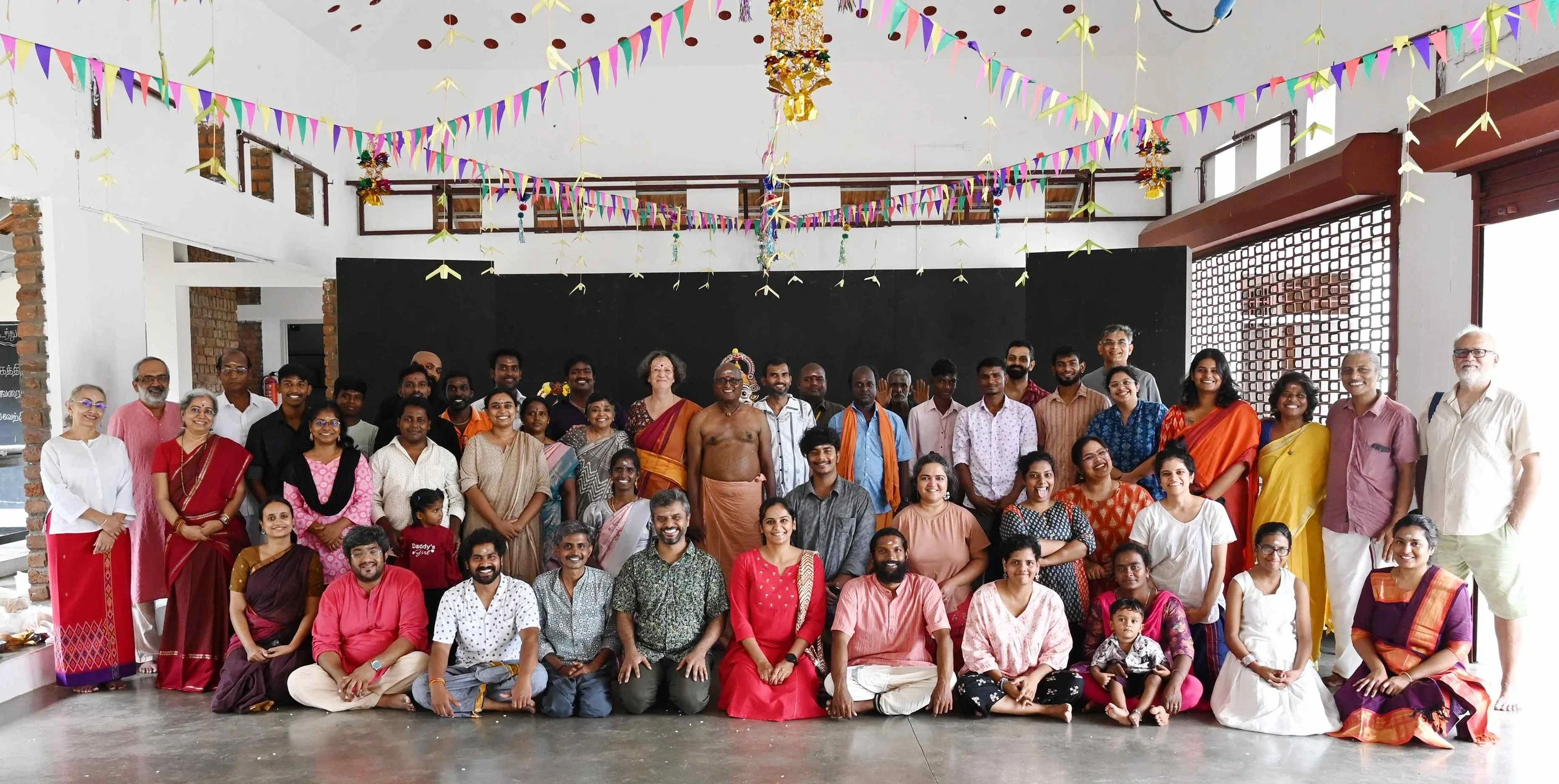
Participants and Guests at the inauguration of the Course on 2 October 2025 (Vijayadasami).
Participants
Participants come from diverse backgrounds and regions. We are excited to welcome 11 individuals who are committed to the full 10-month course. Among them are a theatre actor from Madhya Pradesh and a filmmaker from Mumbai/Goa, while all other candidates come from Tamil Nadu and are Tamil speakers. Additionally, a group of 10 participants has enrolled for the first three-month segment of the course.
Currently, we are engaged in intensive training in Kattaikkuttu, focusing on textual production, music, singing, acting, and movement. We hope to present their first play during the first week of January 2026!
02 October 2025: First-of-its kind Kattaikkuttu Diploma Course inaugurated
Background
The Kattaikkuttu theatre tradition is under threat as experienced experts are rapidly disappearing, and the younger generation is hesitant to pursue it as a profession. Women face significant challenges in entering this field, despite advocacy from the Kattaikkuttu Sangam for gender equality. With the closure of the Kattaikkuttu Gurukulam, there are currently no formal institutions in Tamil Nadu providing training for Kattaikkuttu actors or musicians.
To address these issues, the Sangam has developed a 10-month Kattaikkuttu Diploma Course focused on in-person training. The Course will feed into an online visual and auditory archive for Kattaikkuttu, documenting the transmission of the theatre’s knowledge and skills, in addition to enhancing Kattaikkuttu’s visibility and accessibility beyond its rural contexts.
Unlike other South Indian theatre traditions like Kutiyattam, Kathakali, and Yakshagana, Kattaikkuttu remains under-researched and underrepresented. Our proposed online repository will not only address contemporary challenges but also recover undocumented aspects of Kattaikkuttu's history.
Improving access and visibility is vital to counteract the stigma surrounding Kattaikkuttu and validate its practitioners. The digital living archive will enable anyone interested to engage with Kattaikkuttu and explore its rich theatrical vocabulary.
Vacancies
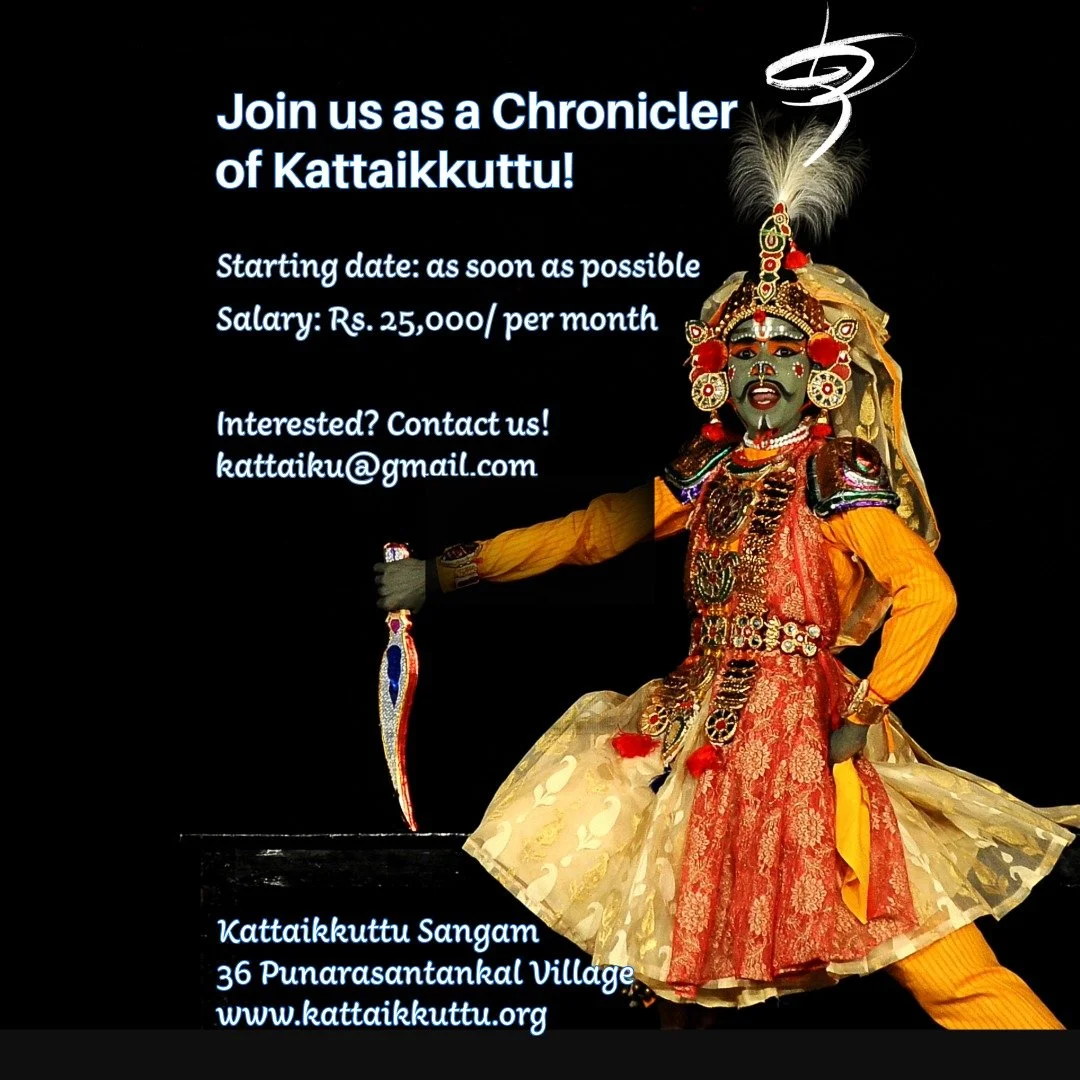
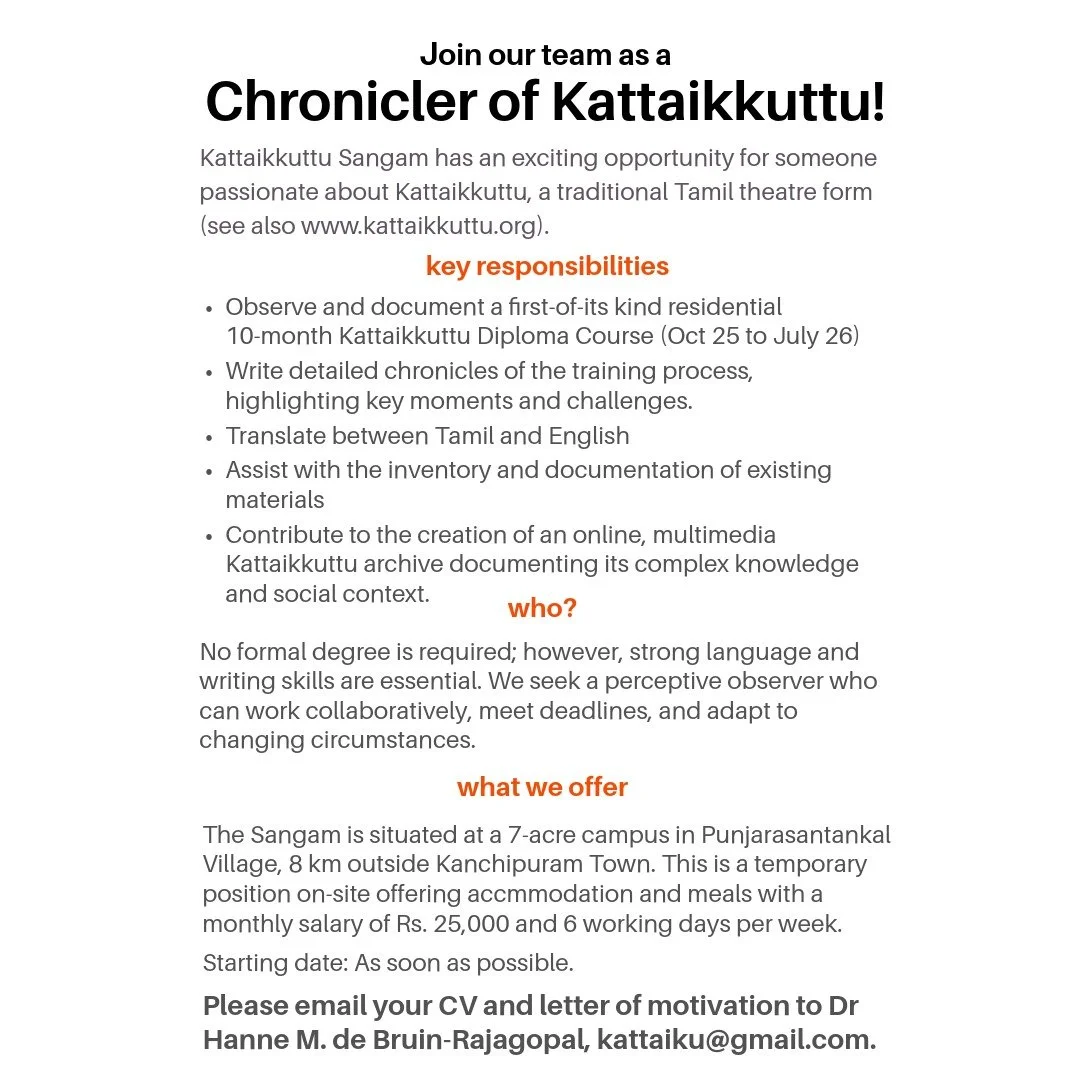
30-09-2025: Chronicler of the Kattaikkuttu Diploma Course
Call closed
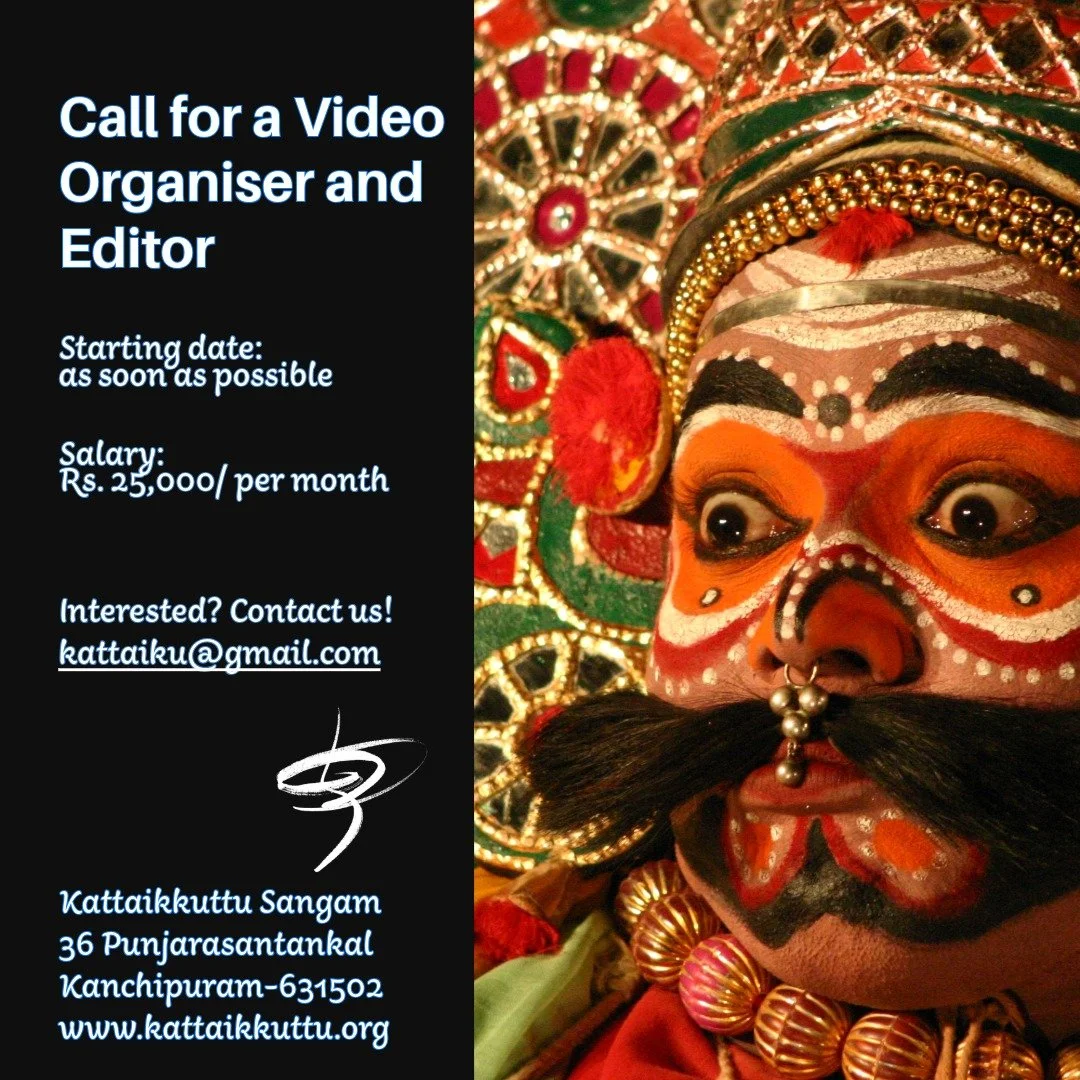
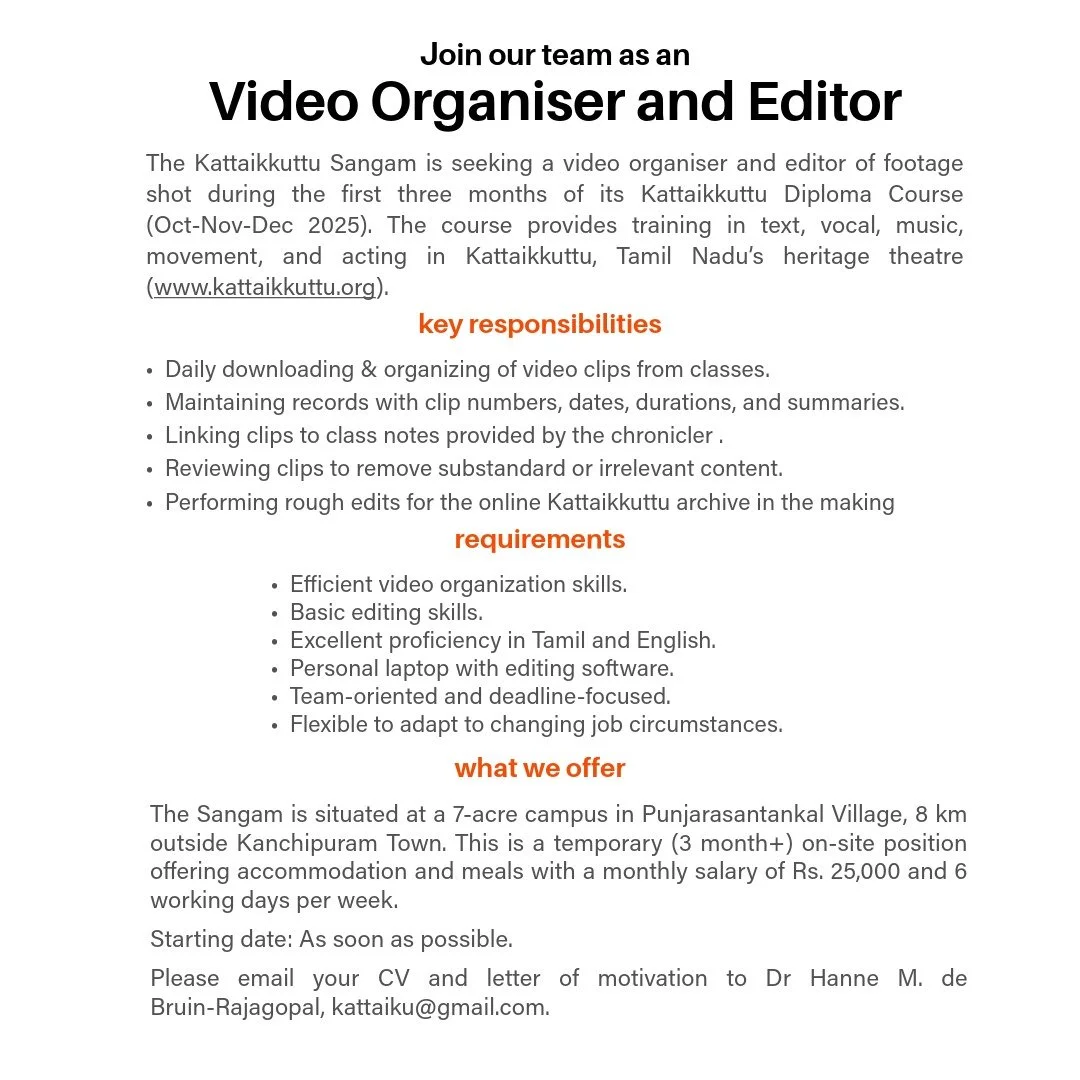
11-10-2025: Video Organizer & Editor
Call closed
Older news
2024
Netherlands ambassador visits the Kattaikkuttu Sangam
20 July 2024
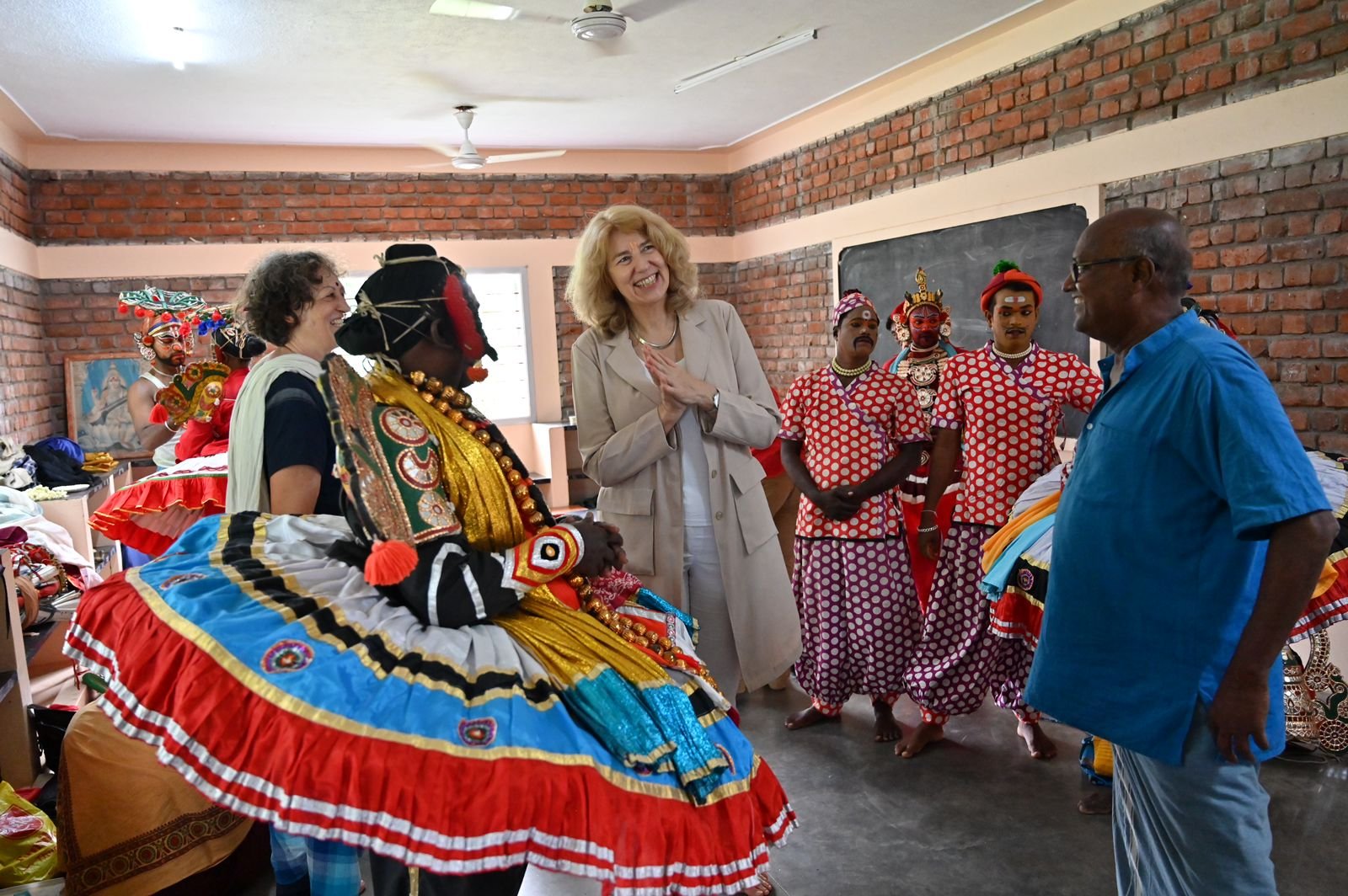
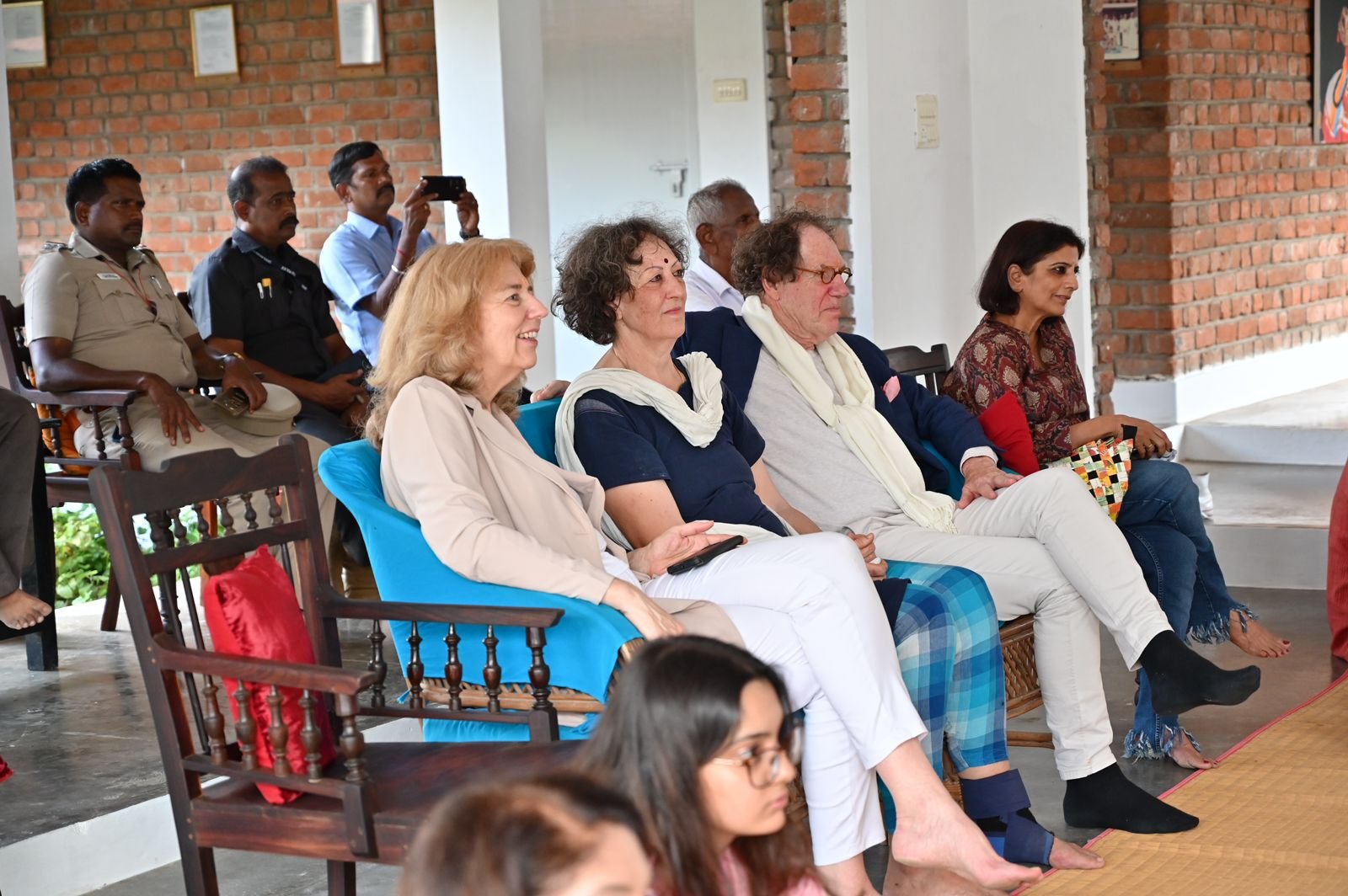
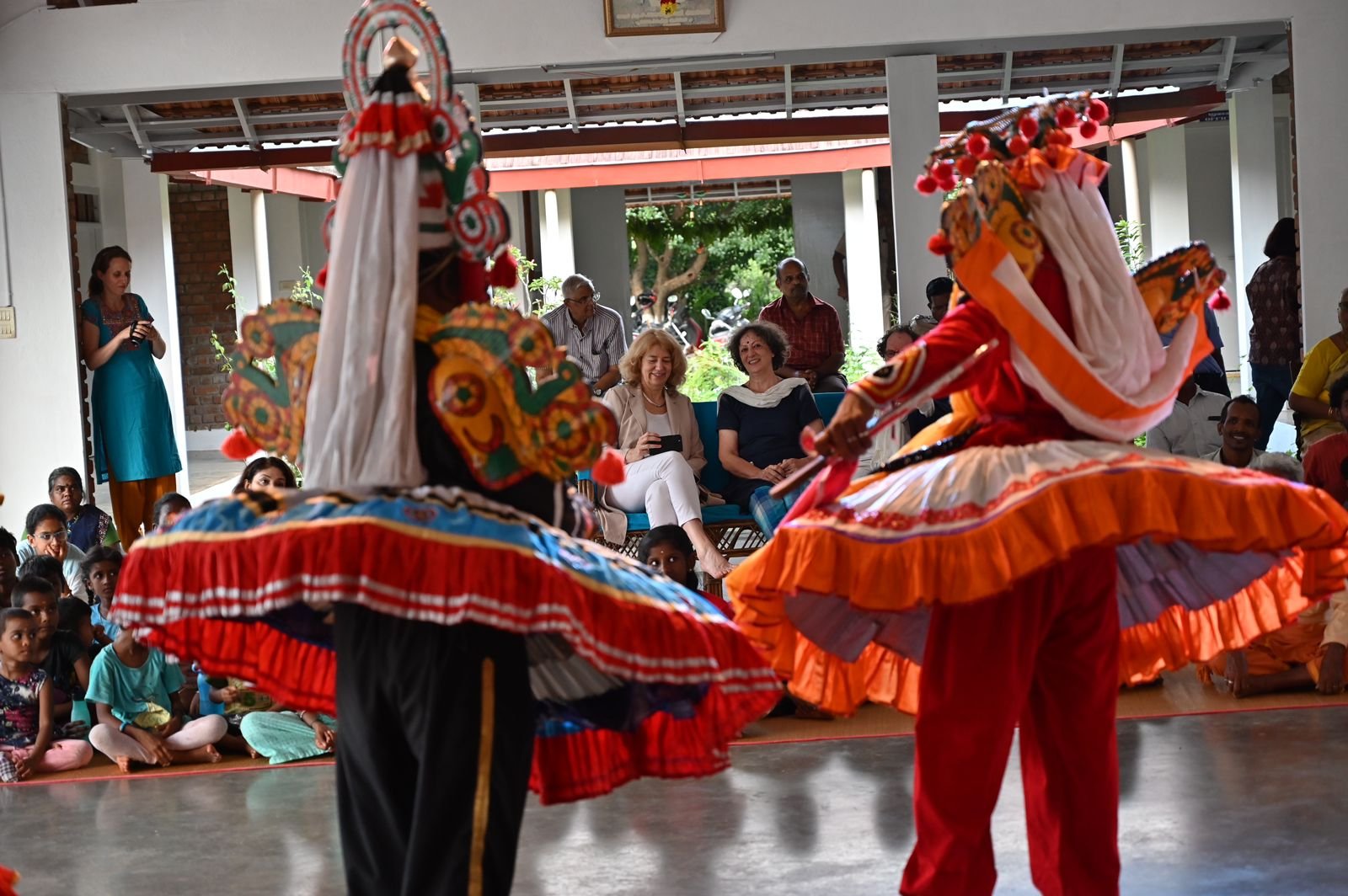
We were extremely honored to receive Mrs. Marisa Gerards, Dutch Ambassador, and her husband Mr. Peter Knoope at the Kattaikkuttu Sangam. They witnessed a performance of Draupadi Kuravanchi followed by a photo-op with the performers who included a number female and male alumni students of the Kattaikkuttu Gurukulam. Her visits helps to put Kattaikkuttu on the map. We look forward to future interactions and new networking opportunities. Thank you so much Mrs. Ambassador!

Parshathy J. Nath writes in The Hindu about the Kattaikkuttu Gurukulam and her experiences of training with P Rajagopal, one of Kattaikkuttu’s senior-most masters, in preparation of her new solo production.
Job openings
At this moment in time we have no any specific job opportunities, but we are open to people who have a desire to work with us to help us foster Kattaikkuttu and the arts in general so as to realize the vision of the Sangam.
If you are an artist, academic, farmer, someone with great media, fundraising or craft skills or someone with a long-cherished creative plan, please contact us to discuss your ideas and expectations with us.
Inspired?
Please get in touch with us at info@kattaikuttu.org
Festival volunteers
The Sangam is organizing Rural Performing Arts Festival spread of 10 subsequent Saturdays in November and December 2024. All performances will be free, but we are eager to use this event to raise funds from local businesses, CSR and through donor passes.
We are in need of passionate volunteers to help us out with the preparations for the fund raising campaign. Are you good at proposal writing? Do you take evocative photographs or video-clips? Would you love to set up a consistent social media campaign to support the fund raiser or revamp our YouTube channel? Do you have hands-on skills and sales expertise to set up and run a stall and selling our merchandise and organic farm produce during the event?
If yes, please contact us! We cannot offer you no remuneration, but we can provide you with onsite accommodation, access to all our training activities and performances and an Volunteering Experience Certificate. We also welcome off-site assistance!
Interested in a Kattaikkuttu Workshop?
Let us know your preferences by filling out the registration form or contact us at info@kattaikkuttu.org. We need a minimum of 10 participants to make a workshop viable.
You can watch a preview of one of our workshops here.
“The most enriching event of 2022 for me were the weekend workshops conducted by the Kattaikkuttu Sangam in the month of November. Rajagopal sir would demonstrate every element we were scheduled to learn that weekend and he would dedicatedly follow each student’s progress and ensure that each one of us were able to fully apply ourselves and understand the movements, dialogues and songs.
Praveen Vijayakumar, Singapore/Ph. D. candidate University of Pennsylvania, USA, 30 Dec 2022.”
Our latest production SANTIPPU is now available for your space!
SANTIPPU (Encounters) is an experimental, minimalist production that mixes and matches Kattaikkuttu and Storytelling in Tamil, English and Tanglish. The production has been conceptualized as a series of encounters the nature of which varies from funny to serious to unreal depending on the participants involved. It uses themes from the traditional Kattaikkuttu repertory, including humoristic intermezzos, and stories from the vast storytelling reservoir, in addition to newly written songs and dialogues.
SANTIPPU is brought to you by senior Kattaikkuttu actor, teacher, director and writer Perungattur P. Rajagopal and Chennai-based veteran storyteller Jeeva Raghunath who together form the company VEKU PARAAKKU. They work without musicians relying on their own voices and bodies to take on different characters, genders and other species.
In part one of SANTIPPU we listen to a lively engagement between the beautiful Azhakan and his devoted wife, the lovely Anbu. This is followed by the famous encounter between Duryodhana and Krishna from the Kattaikkuttu play Krishna’s Embassy. Herein Krishna travels to Hastinapura on behalf of the Pandavas to ask for the return of half of the country. The third meeting features a conversation between Delta and Omicron, while the performance concludes with Kuppusami and Narayanan going off into space.
Concept: P. Rajagopal and Jeeva Raghunath
Dramaturgy and costumes: Hanne M. de Bruin
CALL FOR SUPPORT
to the Kattaikkuttu Women’s Dream Project
The pandemic has severely restricted our access to donor funding. We turn to you again -- as passionate supporters of our work — to elicit your financial and moral support. We are asking you to help us create a space and artistic opportunities for our professional women performers and their young families, who are affected as much by a patriarchal society as by the pandemic.
We aim to raise INR 750000 (EUR 8600 or US$ 10200) to finance salaries for the women, child care and a first production -- now in fast forward mode -- addressing the issues women performers face in a traditional theater form that has been a men-only prerogative.
Please donate directly to the Kattaikkuttu Sangam mentioning "Women's Project". Local donors can avail of our 80G Income Tax exemption. If you are donating from outside India, please use our FCRA account. You can find all relevant bank account details in the table below. You can also donate through our sister organization Kalai Manram in The Netherlands.

TAVAM
The first baby of the Kattaikkuttu Women’s Dream Project has seen the light. Based on the experiences of the 5 women participants in the project as to what it means to be a woman performer in a rural art form that itself is stigmatized, P. Rajagopal wrote the script for a novel contemporary production called TAVAM (“Penance”).
Live version
TAVAM interweaves 3 different threads: that of a sanyasi who has severed his relationships with the social world; scenes from different Kattaikkuttu plays acted in Kattaikkuttu style by the all-women cast; and scenes acted in a more realistic style reflecting situations at home and at the in-laws house of one of the actresses where the women are confronted with the diction: stop performing as you are the talk of the village and will spoil your marriage chances and your family honour. The actresses negotiate their way out of different situations in order to be able to continue their passion, that is performing Kattaikkuttu before and after marriage, as the theatre has become part of their identity.
Interested in hosting TAVAM live at your space or in your festival? Please contact us at info@kattaikkuttu.org.
Film
In collaboration with film maker Sandhya Kumar we made our first-ever foray into the world of film. The cinematic adaptation of TAVAM can be viewed here.
We thank Ranga Shankara Theatre and its donors for making the production of TAVAM and its film version possible.
Please donate
We continue to need your support — financially and in the form of performance opportunities — for the Kattaikkuttu Women’s Dream Project, for the Kattaikkuttu Diploma Course and for the Sangam’s Repertory Company.
We would like to pay our performers well, because a good remuneration provides performers with social dignity, in addition to financial security. And for our women performers in particular women, it gives them much needed leverage to negotiate their continuation in the theatre.
Please support us and donate now!
We have a job opening for a passionate Farm Manager
We are open again!
We are able to receive fully vaccinated visitors and artists-in-residence, who would like to stay on site.
In the ongoing struggle against the Covid-19 pandemic, your safety comes first. We have taken several measures to make your visit to the Sangam as pleasant and safe as possible. Please read our safety protocol and find answers to your questions.
“Perungattur P. Rajagopal: A Portrait of an Actor”
Sue Rees has made a documentary film about actor, director, teacher, playwright, co-founder and moving force behind the Kattaikkuttu Sangam, P. Rajagopal. So far the documentary film has been shown in film festivals in the is Toronto Tamil Film Festival where it won the best documentary award and the South East Asian Film Festival in Chicago.
Sue has been working for and with the Kattaikkuttu Sangam and P. Rajagopal and Hanne M. de Bruin since 2005. This has resulted in some beautiful video images, clips and this long awaited documentary.
New Executive Board
On 23 November 2021 the Kattaikkuttu Sangam elected a new Executive Board during its annual General Body meeting. There was a stiff competition for the various positions within the board. We are happy to welcome 3 new members to the board. Congratulations to all elected members who will be taking on the responsibility to govern the Sangam for the coming 3 years:
President - G. Dhanapal
Vice-president - K. Jalanathan
Secretary - A. Kailasam
Deputy secretary - T.P. Durai
Treasurer - M. Shanmugam
Members of the Executive Board:
K. Maheshwaran
K. Guru
R. Velu
P. Thilagavathy
S. Tamilarasi
T. Veluchami
Annual Report 2021-2022
Our latest annual report is out! It includes a summary of the financial statements.
You can read the Report here.
We thank our auditor Mr. S. Kalyanaraman of K.S. Aiyar & Co. and Mrs. B. Lakshmi, Director finance & statutory compliance, for preparing and auditing the statement
.
Award for P. Rajagopal
The Lions Club of Madras Cathedral honoured P. Rajagopal’s endeavour to transmit Kattaikkuttu to a next generation of young men and women with the Dr. Radhakrishnan Teaching Excellence Award on the 26th of September 2021. Well-deserved this is also an acknowledgement of his almost single-handed attempt to break down gender and caste barriers within and on the rural stage.

February 2023: Another award, this time from the Hyundai Motor India Foundation, in recognition of Rajagopal’s life-long accomplishment as a Kattaikkuttu actor, teacher and passionate promoter of the theatre itself.
